
Algorithmed

I’ve been thinking a lot about algorithms lately. From a business point of view, I can certainly understand why websites, streaming services, and social media sites want to feed us information that is in keeping with other information we have paid attention to in the past, assuming that diving deeper into that rabbit hole will make us click on more product they are pushing, spend more of our attention on it, and hopefully be persuaded by some of their ads to make purchases that will bring them income.
I get it.
But that doesn’t mean I have to like it.
It made me wonder what it would be like to watch Netflix without being prodded to watch movies or TV series that are similar to ones that I have watched in the past. Likewise, what would it be like to listen to Spotify or watch YouTube and simply hear what I requested rather than use that as a starting point for pushing all other kinds of music or videos. I would like it that way.
Case in point: Sunday, I heard a wonderful live performance of the Duruflé Requiem by a true gem of our Pioneer Valley, the Illumine Vocal Arts Ensemble.
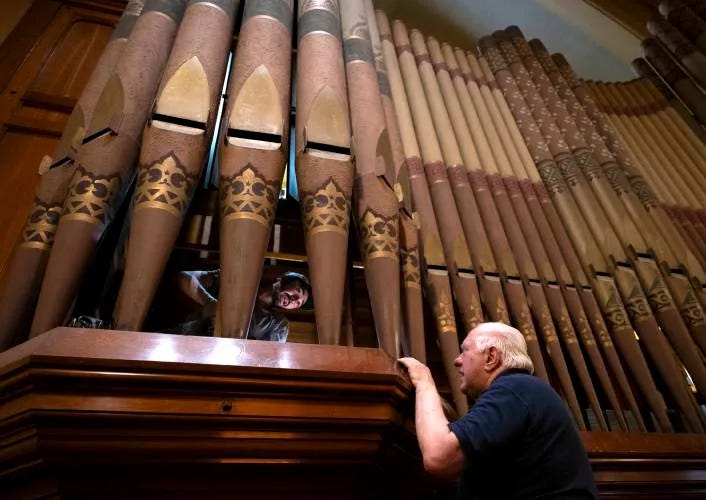
The performance was quite memorable for many reasons, not the least of which is that it was accompanied by the newly refurbished Skinner organ that makes its home in First Churches of Northampton.
While I was preparing dinner later in the evening, I politely asked my Alexa device to play a version of the Requiem that I had linked from Spotify. So far, so good. But after it was over, it went off the rails playing all kinds of other pieces -- some related (other requiems), and some off the wall, but none desired. When the requested album is over, it should just stop. But Alexa’s masters have apparently reasoned that stopping won’t keep me clicking. (sigh)
When the algorithm keeps pushing me stuff, it just keeps coming until I tell it to stop. Likewise, when I look at the social media feeds in Facebook or Instagram, it just keeps sending ads and posts that it thinks I would like to click on and spend money on. I don’t want their clickbait. And in fact I canceled my Instagram account a year ago and do not look at my Facebook account any longer.
I finally decided to cancel my FB account after receiving the following email today:
Dear Hal, On December 16, 2025, we’re making changes to our Privacy Policy. Here are some details. We’ll start using your interactions with AIs to personalize your experiences and ads. What this means: Personalizing your experiences includes suggesting content like posts that you may find interesting and reels to watch. It also includes showing ads that are more relevant to you. Thanks, Meta Privacy
I do not want my AI interactions to be “personalizing my experiences” so that they are more “interesting” or “relevant.” Nevertheless, this shouldn’t surprise me -- but now even my interactions with AI will be used against me. No thanks. Over and out.
My intentions became more resolute when I read the following in the NY Times, also this morning: “How A.I. Can Use Your Personal Data to Hurt Your Neighbor.”
The jist of the article is that AI is increasingly being used not just at the individual level -- that the actions you take online are preserved and used to shape future online interactions -- but that your actions, combined with those of others deemed to be like you, are basically used to profile your “type” and make decisions and predictions which might not only affect you, but also others like you ... hence, the headline that AI can use your personal data to hurt your neighbor. I found this chilling. I am almost never surprised any more, but that doesn’t mean a revelation like this can’t generate a chill or two.
Digest this (from the NYT article): “It doesn’t matter that you practice safe digital privacy: keeping most personal details to yourself, avoiding sharing opinions online and prohibiting apps and websites from tracking you. Based on the scant details it has of you, the A.I. predicts how you’ll behave at work, based on patterns it has learned from countless other people like you. This is increasingly life under A.I. Banks can use algorithms to decide who gets a loan, learning from past borrowers to predict who will default. Some police departments have fed years of criminal activity and arrest records into “predictive policing” algorithms that have sometimes sent officers back to patrol the same neighborhoods.”
Lest you think that I am a Luddite, I must say that I find certain aspects of AI quite compelling. My most recent adventure was to see if I could get Chat GPT to transpose a piece of music and prepare a voice and piano score in the new key. I’m still working on that and hope that it can oblige. I may have to upgrade to the $20/month plan, but I’m close to hitting that upgrade button.
But I would feel much better if individuals could actively opt in to algorithmically-directed systems rather than be forced in by default. (I guess you could say that hitting “I agree” to the multipage fine print we get whenever a system is upgraded counts as opting in, but there is no choice -- either hit “I agree” or get lost.)
To counteract any bitterness I may have conveyed in this essay, I close by sharing a beautiful live recording of the Duruflé Requiem, performed by the Choir of Trinity College Cambridge (under the direction of Stephen Layton) in the Eglise Saint-Eustache in Paris in 2022. (It’s the most stunning performance of this piece that I have heard. The extraordinary choir was singing from memory, and the choristers were consequently able to respond to every subtle cue of the director while listening closely to each other. The video will pull you in and transport you.)
The setting has special meaning to me. When I visited Paris in 2013, I was wandering around my neighborhood on an exceptionally hot July afternoon and came across this beautiful gem of a Gothic church built between 1530 - 1620. My aching feet and overheated body pushed me inside, where I was witness to a sweet infant baptism - but then saw an announcement of a free organ concert the next day - which ended up being quite special, featuring music by Duruflé, Franck, and Prokofiev. Afterwards, I wrote, “The gorgeous sounds FILLED that Gothic church from bottom to top with glorious sounds in waves and waves.”
With that as backstory, here is a link to the Requiem (45:17, and well worth the listen.) I hope you enjoy it as much as I have.
I don't think about algorithms but am always amazed at how much comfort you find in music.